Why trusting your ears is no longer enough when a panicked caller sounds just like someone you love—and the simple offline habit that shuts scammers down.
Your phone buzzes at 10:15 PM. Unknown number. You answer anyway, and the voice on the other end stops your heart cold. It sounds exactly like your daughter, breathless and crying. There was a car wreck, her phone shattered, she is borrowing a stranger's line, and she needs bail money wired right now before they lock her up for the night.
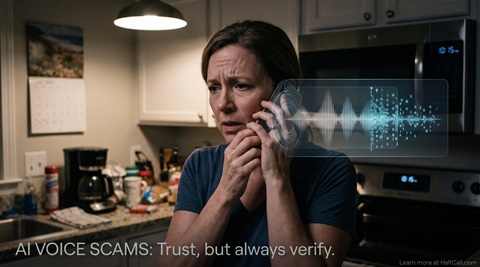
Your pulse spikes. Your hands shake. Before your logical brain even catches up, you are already reaching for your wallet.
That split second of panic is the real engine behind modern AI voice scams. The technology gets the headlines, but the weapon is still raw human instinct.
A few years ago, cloning someone's voice required hours of clean studio recordings. Today, commercially available speech models can generate a convincing vocal match from roughly three seconds of audio. Scammers pull those clips from outgoing voicemail greetings, public social media videos, podcast appearances, or even a ten-second spam call where they just wait for you to say "Hello? Who is this?".
Once they have the voice, they pair it with scraped personal details—your street address, your relatives' names, where your kids go to school—pulled from data breaches and public profiles. The scale is already staggering: the FBI logged more than 22,000 AI-related fraud complaints totaling $893 million in losses in 2025 alone, while voice-phishing attacks have surged sharply across both households and businesses.
Old scam advice told people to listen for robotic phrasing, awkward grammar, or thick accents. That playbook is dead. Synthetic speech now mimics breathing pauses, slight hesitations, and regional cadence.
Even better for the thief, emergency scripts come with built-in camouflage. Static on the line, muffled crying, and frantic shouting hide the tiny digital artifacts that might otherwise give a clone away. When you think a loved one is hurt, your brain actively fills in the blanks because you *want* to recognize them. Relying on "I would know my own kid's voice" is how careful, smart people lose thousands of dollars in ten minutes.
No spam blocker or paid security app can reliably detect a cloned voice traveling over a standard phone line. What actually works is boring, fast, and free:
1. Hang up and call back on a saved number. Scammers can spoof Caller ID and clone a voice, but they cannot intercept a call placed directly to your relative's real phone. If they don't answer, call a spouse, sibling, or coworker who knows where they are.
2. Demand a shared safe code. A clone can copy a voice, not a secret. The catch with static family passwords is that people forget them after six months—or accidentally reuse them. A simple, privacy-first tool like HaltCall.com fixes that gap by generating a rotating daily two-word safe code and printable callback cards right on your device, with no accounts, servers, or tracking. If a panicked caller cannot give you today's two words, you hang up without guilt.
The worst time to invent a verification rule is while someone is sobbing in your ear. Take five minutes at dinner or in your family group chat to make one agreement crystal clear: nobody sends a wire transfer, crypto, or gift cards based on a phone call alone.
Real emergencies survive a thirty-second callback. Scams never do.
Copyright (c) polish-translators.net
Fax: (309) 4236-469
Designed by Quis Research